
Journalistic analysis by: Dr. Abdelaziz Tarekji
– Investigative Journalist and Researcher in International Human rights violations
On August 15, 2025, the Alaska Summit was held between U.S. President Donald Trump and Russian President Vladimir Putin at the “Elmendorf–Richardson” base in Anchorage.
The summit ended without an announced agreement on the war in Ukraine, but it opened two parallel paths: an American attempt to accelerate a negotiating process leading to a “security deal” for Ukraine, and a Russian effort to use the moment to achieve bilateral thaw — and perhaps partnerships in the Arctic — while keeping its field gains in Ukraine without concessions.
Beijing, for its part, interpreted the summit as a return to the policy of “balance of poles” and the possibility of being included as a guarantor or mediator, which makes the “East” here mean both Eastern Europe and Asia together at the same table.
What really happened in Alaska?
The summit concluded without a breakthrough; analysts described it as changing the “tone” more than the “facts.”
Trump emerged hinting at a “deal” that included security guarantees for Kyiv, while Putin clung to his political and military ceiling without offering substantial concessions.
After the summit, Putin said there was “light at the end of the tunnel” in relations with Washington, and spoke of opportunities for cooperation in Alaska and the Arctic (energy, shipping routes), suggesting that the Ukrainian file be linked to a broader bilateral package.
On the Ukrainian side, Washington pushed for meetings at the White House with Volodymyr Zelensky and European partners to define lines of security guarantees; Europeans read the summit cautiously: no “grand deal” for now, but the direction of the process requires vigilance.
Where does Beijing stand… and what does its “entry” mean?
In the Chinese public reading: a cautious welcome to any “peace facilitating” efforts, keeping the bet on the role of “potential guarantor” and not direct mediator — Beijing observes without becoming involved, seeking strategic gains whether the balance tilts toward Moscow or toward Washington.
In the strategic reading: Beijing sees the summit as the consolidation of “great power concertation”; if Russia is given an exit in Ukraine, this could be reflected in deterrence equations in East Asia (Taiwan, South China Sea). That is why it examines the firmness of the West: “if Ukraine is pushed into territorial concessions, those calculations are transferred to Asia.”
Asian reports and opinions noted that Washington might try to “strain” the Moscow–Beijing axis through bilateral incentives to Russia (Arctic and energy); Moscow could benefit by reducing its economic dependence on Beijing, while China gains geopolitical momentum in any scenario.
Key statements of leaders and what they imply
Putin: spoke of “light at the end of the tunnel” for his country’s relations with the U.S., and linked the statement to opportunities for cooperation in the Arctic and Alaska — a double message: willingness for economic/Arctic exchanges in return for American recognition of Russian facts on the ground in Ukraine.
Trump: after the summit promoted the assembly of a “security guarantees” package for Kyiv; the change was not in the “outcomes,” but in the “priorities” and way of managing the file — accelerating a “cold peace” rather than a “hot victory.”
Lavrov: hinted at readiness to meet Zelensky, questioning the constitutional “legitimacy” of the Ukrainian president, and linking any progress to an “architecture of guarantees” that would give Russia veto power — a central point of contention.
Zelensky: stressed rejection of “decisions without Ukraine,” and demanded clear U.S. and European support if the bilateral meeting fails.
Chinese signals (in media and studies): references to a “balance among three poles” and to China being the biggest beneficiary of any U.S. easing of pressure on Moscow, or of any rift in the Moscow–Washington axis.
What does this equation mean for the two “Easts”?
Eastern Europe (Ukraine): The most likely direction is to attempt to build a security deal that consolidates current front lines under a framework of gradual guarantees (armament, training, air defense) without immediate NATO membership — a “fenced peace” that requires sponsors and guarantors.
The proposal to include China as a guarantor is not ruled out by Russia; Europeans are cautious, and Kyiv insists on the integrity of its territory.
East Asia (Taiwan and Chinese seas): Any perception of Western weakness in Ukraine is immediately measured in Asia. That is why Washington emphasizes sustained deterrence power in the Indo–Pacific, while Beijing assesses the “price of risk.” Its bet: practical recognition of spheres of influence in exchange for moderating behavior in straits and passages.
Direction lines: how are the results of the summit “managed”?
American approach: drive a “quick and constructive” negotiating process while keeping economic pressure on Moscow, and mobilizing Europeans to detail guarantees so they do not become open-ended commitments. The bet: consolidating a “long truce” instead of a near-term comprehensive peace.
Russian approach: accumulating political gains just by sitting at the table of equals, and promoting Arctic/energy partnerships with Washington to reduce economic dependence on China, while insisting on a high negotiating ceiling over Ukraine.
Chinese approach: remain in the “seat of potential guarantor” rather than actual mediator, interpreting every U.S.–Russian gesture through the lens of deterrence in East Asia. China’s gain exists whether Washington manages to “decouple” Moscow from Beijing or fails — in both cases China’s importance as a balancing pole grows.
What to watch in the coming weeks?
Will a Putin–Zelensky meeting actually take place? And what will be the nature of the proposed “guarantees” and who will sign them? (The debate over Russia’s veto on Ukrainian security will be the biggest test).
Will bilateral Arctic projects (energy/navigation) between Washington and Moscow materialize? If so, the “Arctic quid pro quo” at the expense of toughness on Ukraine will become a hot internal issue in the West.
Will Beijing’s official stance in its upcoming press conferences remain in rhetoric or move to a concrete “architectural proposal” for the guarantees framework?
Conclusion
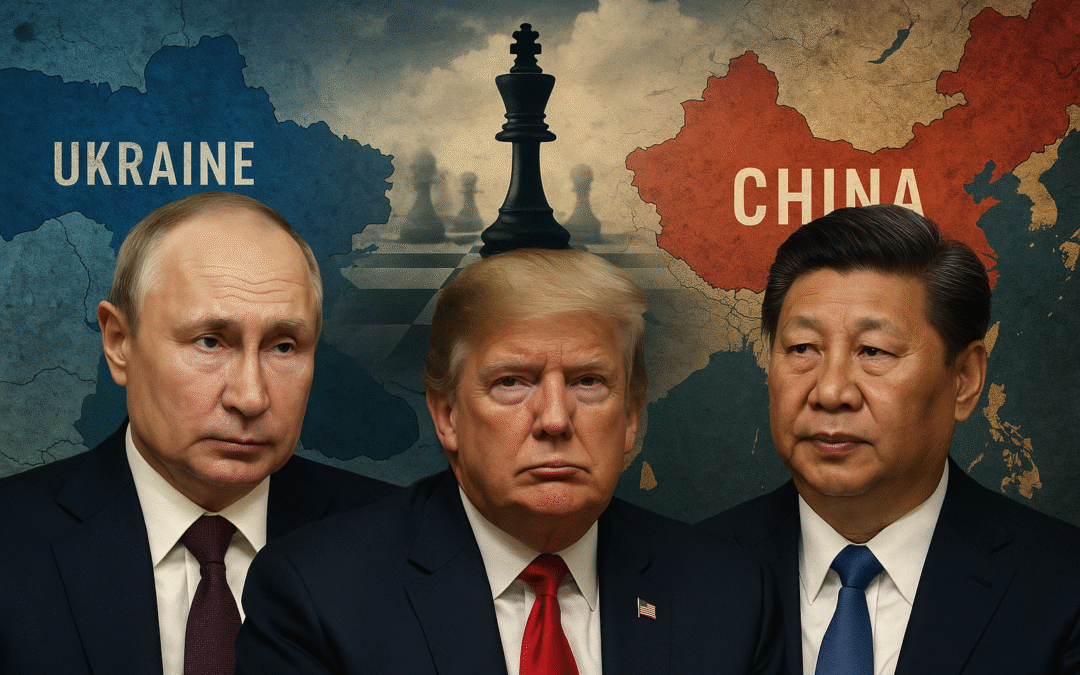
The Alaska Summit did not sign any formal agreement, but it rearranged the chess pieces on a board that goes beyond Ukraine to include East Asia and polar routes.
Washington came out of the summit seeking to impose a “fenced peace” in Ukraine, based on conditional security guarantees that prevent a direct military commitment, while at the same time reassuring its European allies fearful of deals made over their heads.
Moscow, for its part, achieved more than just dialogue; it consolidated the image of “equality” in the face of the West, and waved new cards in the Arctic and energy, testing the limits of possible benefits without offering substantial concessions on the Ukrainian ground.
Beijing, meanwhile, sat in the seat of the shrewd observer who intervenes only insofar as it increases its importance. It reads between the lines of Alaska’s communiqués signs of a new balance among great powers, and prepares to reap benefits whether negotiations lead to a long truce or to a deeper rift between Moscow and Washington.
For China, any reduction in Western pressure on Russia means strengthening its strategic position in Asia, and any U.S. attempt to separate Russia from China increases the value of its role as a “potential guarantor” and indispensable pole.
In this sense, the summit cannot be considered a solution, but rather a long-term crisis management. It has generated a new dynamic that reconnects Eastern Europe and East Asia with a single thread of power balances, where every move in Kharkiv or Donbas is assessed for its impact on the Taiwan Strait and the South China Sea.
The entire scene does not herald a near peace, but rather a transitional phase full of concessions and tests, where interests intersect and wills collide, and where tomorrow’s world politics are written on Alaska’s ice with ink of Ukrainian fire and Asian shadows.