By: Dr. Abdelaziz Tarekji
Investigative journalist and researcher on international human rights violations
.
With the beginning of a new year, the world once again stands before a harsh mirror reflecting the scale of the collective failure to protect the human being—a failure that cannot be justified by the absence of laws or the lack of treaties, but rather exposes, in a striking manner, the absence of political will, the instrumentalization of international justice systems to serve narrow interests, and the transformation of human rights from a binding legal obligation into a selective tool applied or ignored according to the balance of power rather than the balance of justice.
Contemporary experience has demonstrated that the problem has never been rooted in legal texts. International humanitarian law, human rights treaties, and peremptory norms from which no derogation is permitted were fundamentally established to protect human dignity as an absolute value, not subject to bargaining or political manipulation. Yet what the world witnesses today is a grave deviation from this path, whereby principles are suspended at the first test, obligations are emptied of substance, and the human being is left alone to face the machinery of violence and conflict.
In this context, peace is no longer a mere moral aspiration or a rhetorical slogan invoked in conferences and seasonal speeches. It has become an existential necessity for the survival of societies, the continuity of States, and the protection of human civilization itself from self-destruction. The absence of peace no longer threatens specific regions alone; it undermines international stability as a whole, erodes the foundations of collective security, and transforms the world into an open arena for chaos, crime, and terrorism.
Peace, from the perspective of international law, is not a political option subject to postponement, but a legal and ethical commitment that precedes all considerations, for the alternative is nothing but more bloodshed, more violations, and a deeper erosion of trust in the international system itself.
.
A World Burdened by Conflicts… and a Human Being Who Pays the Price
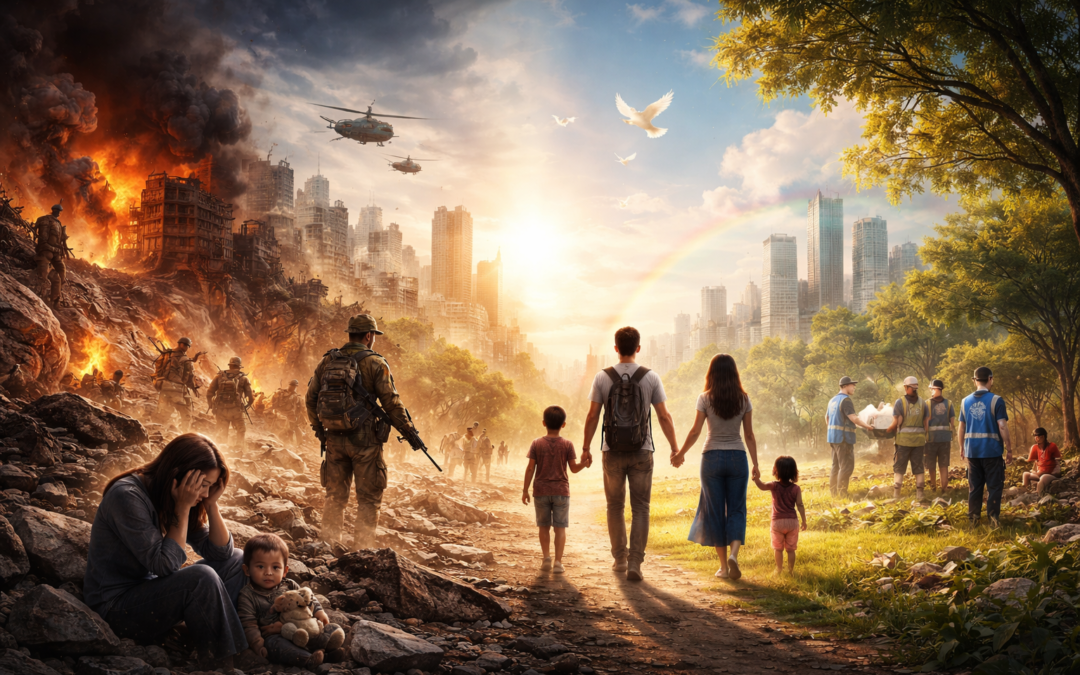
Across various regions of the globe, wars multiply and armed conflicts expand at an alarming pace, while peoples are exhausted by direct bombardment that makes no distinction between civilians and combatants, economic blockades employed as collective weapons, systematic violence exercised by authorities or armed groups, and transnational terrorism that feeds on chaos and the absence of justice.
These realities are no longer isolated or temporary exceptions; they have become a recurring pattern, often managed under the cover of international silence or deliberate incapacity.
Each time, the human being is the first and last victim, in a clear violation of the principle of general protection of civilians enshrined in international humanitarian law.
A child deprived of the natural right to education and to a safe life, in direct breach of States’ obligations to protect childhood.
A woman stripped of her dignity and subjected to physical or psychological harm, in blatant disregard of the principle of non-discrimination and the prohibition of gender-based violence.
A civilian killed without guilt, outside any military necessity, in a manifest violation of the right to life as a fundamental and non-derogable right.
And an entire society forcibly driven toward poverty, crime, and extremism as a result of repressive policies that generate fertile environments for the collapse of social peace and the disintegration of the social fabric.
The persistence of this reality reflects not only political failure but constitutes a flagrant violation of the very essence of international law, which was established to protect the human being—not to justify killing, legitimize suffering, or cosmeticize silence when the political cost of accountability is deemed too high. When the human being is left without protection, laws turn into empty texts, and the international system shifts from a framework of protection to an impotent witness of violation.
.
International Law: Between Text and Implementation
International instruments, foremost among them the Charter of the United Nations and the Universal Declaration of Human Rights, enshrined a principle that admits neither restrictive interpretation nor diminution: the protection of the human being, the safeguarding of human dignity, and the guarantee of the inalienable right to life, security, and peace.
This principle was not formulated as a moral recommendation or a political orientation, but as a binding legal obligation upon States and as a cornerstone of the contemporary international system.
Yet present reality reveals a dangerous paradox that threatens the credibility of that system.
Laws are raised as slogans in international forums without translating into effective implementation.
Institutions are used as formal façades, managed according to power balances rather than standards of justice.
Human rights concepts are emptied of substance when reduced to selective condemnations or calculated silence.
Within this framework, violence is granted legitimacy when it serves the interests of influential powers, while forms of defense or resistance are condemned when they do not align with prevailing political calculations—an evident contradiction of the principle of equality before the law and the prohibition of discrimination in the application of international norms.
The greatest threat facing the international system today is not the absence or weakness of legal texts, but double standards, selective justice, and the conversion of human rights from an imperative legal reference into a tool of political pressure. When rights are used in this manner, they lose their ethical essence, and international law ceases to be a shield of protection, becoming instead a means of justification—shifting from guarantor of the human being to a silent witness of violation.
.
Peace and Development: An Inseparable Equation
It is impossible to speak of genuine human development amid wars, nor of sustainable security in environments ravaged by poverty and marginalization, nor of combating organized crime or terrorism without addressing their structural roots. International experience has shown that violence does not arise from a vacuum; it flourishes where justice is absent, rights are suppressed, and the human being is economically and socially marginalized.
Peace, in this sense, is not merely the absence of weapons or a temporary ceasefire, but a comprehensive condition founded upon:
the presence of justice as the primary guarantee of stability,
equal opportunity as the basis of social peace,
respect for human dignity as an inviolable red line,
and the construction of a State governed by the rule of law and institutions, not by force and domination.
Where genuine peace is absent, organized crime thrives, terrorism expands, and societies become fragile environments prone to explosion at any moment, regardless of the scale of military or security expenditure. Coercive security does not produce stability; it merely postpones explosion and deepens its causes.
.
The Responsibility of States… Before Rhetoric
All States, without exception, are today required to undertake a profound review of their policies and to return to the core of their legal and ethical commitments voluntarily assumed upon joining the international system.
What is required is not further rhetoric, but clear policies based on:
protecting civilians rather than justifying their targeting under any pretext,
respecting national sovereignty rather than violating it in the name of interests or selective interventions,
combating terrorism without manufacturing its causes through injustice, exclusion, and repression,
and supporting genuine peace without investing in wars or fueling conflicts.
There is no legitimacy for authority sustained by fear, no stability for a State that builds its security upon rights violations, and no credibility for a human rights discourse used to settle political scores instead of delivering justice to victims.
.
A Call for 2026: Putting the Human Being First
With the advent of 2026, it is no longer acceptable to continue managing the world through the logic of postponed crises, nor to treat the human being as a statistic in reports or a bargaining chip used and discarded at tables of international interests.
Peace is no longer a political option subject to negotiation or delay;
it is a legal obligation imposed by international treaties, a human priority dictated by dignity, and a collective responsibility borne by States, institutions, and societies.
Any international system that fails to place the human being at the center of its decisions and to make protection the primary objective of every public, security, or economic policy will remain a fragile system, devoid of ethical and legal legitimacy, regardless of the power or influence it possesses.