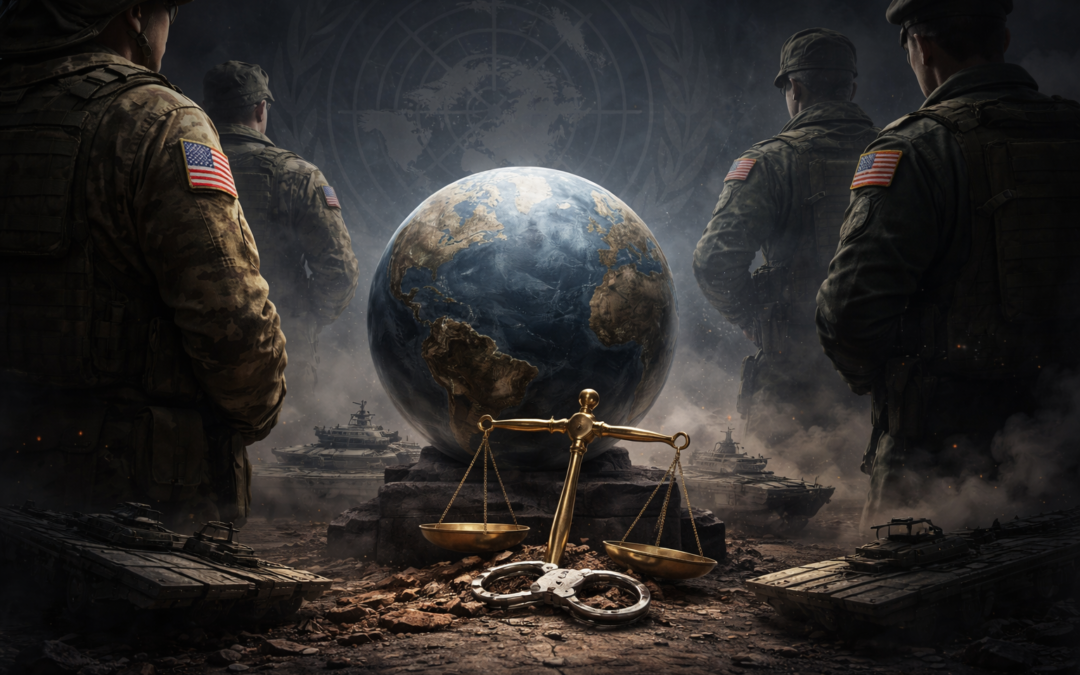
A comprehensive reading: a world that arrests presidents… and justifies it with statements
Venezuela after Maduro: rules broken, allies silent, in a hypocritical international order
.
By: Dr. Abdelaziz Tarekji
Investigative journalist and researcher on international human-rights violations
.
To begin: not a defense of Maduro… but of the legal rule
Before engaging in any political analysis or forecasting what may come next, one essential point must be fixed beyond ambiguity: this article is not a defense of Nicolás Maduro as a person, nor does it grant his government political or moral legitimacy; nor does it revoke it.
The dispute over his legitimacy—whether regarding elections, mandate, or the exercise of power—remains a strictly internal Venezuelan matter, to be settled through constitutional mechanisms, the ballot box, and the will of the Venezuelan people alone, without external tutelage or coercive intervention.
What has occurred, however, goes beyond Maduro as an individual or as a controversial president and strikes at an essential rule of international law: that disagreements over any leader’s legitimacy—however intense—do not justify overthrowing or arresting him through external action, nor do they authorize any state or coalition to substitute itself for the people in determining their destiny.
Accepting the breach of this rule under the pretext of political disagreement or non-recognition of governmental legitimacy effectively strips peoples of their political right and turns sovereignty from a binding principle into a selective concept—applied rigorously to the weak and suspended in the face of the powerful.
Defending this rule, therefore, is not defending Maduro; it is defending peoples’ right to self-determination free of coercion, and what remains of an international order grounded in law rather than the naked logic of force.
.
First: breaking the foundational rules of the international order
What happened—if confirmed with all its facts and contexts—cannot be described as an exceptional political measure or a passing security episode. It constitutes a serious and explicit breach of core principles upon which the contemporary international order has rested since the end of the Second World War.
Foremost among these principles are:
- Sovereignty and non-intervention, enshrined in Article 2(7) of the UN Charter, prohibiting states from intervening in the internal affairs of others—particularly when it comes to shaping government or changing political leadership.
- The prohibition of the use or threat of force, under Article 2(4), widely regarded as a peremptory norm of international law, with only narrow exceptions for self-defense or explicit Security Council authorization.
- The personal and functional immunity of sitting heads of state, a well-established rule of customary international law affirmed by international judicial practice, designed to preserve stability in interstate relations and prevent political disputes from turning into coercive acts.
These principles are not mere moral slogans or diplomatic rhetoric. They are peremptory legal foundations (Jus Cogens) crafted precisely to prevent a return to raw power politics—where facts are imposed by arms rather than law, and disputes are settled by hegemony rather than legitimacy.
Violating these rules under any political pretext does not affect Venezuela alone. It shakes confidence in the entire architecture of international legal protection and sends a troubling message: that supposedly general and binding norms can be suspended or evaded when the target is a weak or isolated state.
The real danger lies not only in the act itself, but in normalizing its breach without meaningful international accountability.
.
Second: major allies… alliances for speeches, not for stress tests
One of the most urgent questions after what occurred is: where are Maduro’s major allies? And what became of the rhetoric about strategic alliances, security agreements, and “anti-hegemony” blocs?
The answer—however unsettling—is simple in the logic of international relations: alliances are not measured in statements, but in moments of high cost.
.
Russia: pragmatism over confrontation
Despite supportive political and military rhetoric, Russia did not act effectively. This was not “moral abandonment” or “political betrayal,” but a cold strategic calculation governed by power realities:
- Russia is waging an existential war in Ukraine, draining its military, economic, and diplomatic capacities.
- Moscow lacks effective logistical or deployment capability in the Western Hemisphere—no bases, no reliable supply lines, no posture for direct confrontation.
- Any move on behalf of a besieged Venezuelan regime would mean direct confrontation with the United States in its traditional sphere—beyond Russia’s acceptable risk threshold.
Result: Russia condemns and denounces, but does not fight for regimes that are not existential priorities.
.
China: the state before the regime; interests before individuals
China chose practical silence—a calculated silence. In its foreign policy, it does not defend individuals or regimes as ends in themselves. It defends three pillars:
- long-term stability
- resources and economic interests
- the state as an enduring entity
Beijing does not bet on “saving a regime,” but on adapting to what comes after it. It keeps lines open with any future authority as long as strategic interests are secured. Under this logic, Maduro was not an irreplaceable asset for China.
.
Iran: influence without existential defense
Iran’s alignment with Caracas has been economic, technical, and symbolic in the broader context of challenging Washington—but never an existential defense pact. For Tehran, Venezuela is a remote platform of influence, not a battlefield worth direct military confrontation or expanded sanctions exposure. Hence, Iranian support remained political and media-driven.
.
North Korea: high ideology, low capability
North Korea maintains a high-ceiling ideological posture, yet it is geographically isolated, operationally limited beyond its region, and has no interest in opening a global front that does not serve regime survival. Its role remained symbolic, not consequential.
.
Conclusion: the myth of solid alliances—and the limits of protecting dictatorships
These facts reveal a truth often hidden behind slogans: contemporary alliances are not permanent shields; they are conditional networks of moving interests.
External backing for any regime—including those widely classified as dictatorships, such as Maduro’s—endures only while the political and military cost is low, and evaporates once it becomes a strategic risk, a global political burden, or an undesirable legal precedent.
There is another decisive truth: regimes that rely on internal repression and accumulate legitimacy through force rather than consent remain fragile, regardless of how powerful their patrons are. Recent history shows that alliances supporting authoritarian systems—from the Middle East to Latin America—were never guarantees of survival, only temporary postponements of an outcome.
The fate of any regime practicing systematic repression is not decided in allies’ rooms or in press releases, but at home—where legitimacy erodes and governing capacity exhausts. When a regime becomes an ethical and political liability, it is left alone—not because the world is fairer, but because it is more pragmatic.
Thus, the fall of dictatorships, sooner or later, is a matter of time. The true danger is not their end, but the illegal methods that may be used to bring them down—and what that means: breaking rules and threatening the international order as a whole.
.
Third: Latin American allies… when fear outweighs ideology
If global allies’ silence is driven by power calculations, Latin American positions are shaped by a heavy historical memory: confronting the United States has rarely been a manageable option—more often a guaranteed recipe for political and economic loss.
Cuba, Nicaragua, Mexico, Brazil, and Colombia each face constraints—economic fragility, isolation, geography, security dependencies, and state interests—that make escalation irrational.
Conclusion: Latin America aligned with Maduro rhetorically, but was never prepared to defend him in practice. The familiar pattern persists: solidarity in statements, silence at the moment of truth.
.
Fourth: a hypocritical world… why doesn’t the “international community” act?
The question is not why it did not act, but: what is the “international community”?
It is not a global moral court nor a neutral authority. It is an unequal system where power precedes principles and interests precede values.
This structural imbalance is visible in:
- a Security Council paralyzed by the veto
- international institutions constrained by funding and political pressure
- selective international law: strict against the weak, flexible before the strong
In that context, silence is predictable: real objection is costly, while political hypocrisy—“concern” statements and vague calls for restraint—is cheap and safe. The system is managed not as an architecture of justice, but as a mechanism for recycling crises and avoiding confrontation with power centers—even if the price is eroding the rules it claims to protect.
.
Fifth: where is Venezuela headed? Post-Maduro scenarios
Maduro’s arrest does not open a clean new page; it pushes Venezuela into a complex transition shaped by internal dynamics and external pressure, with no purely sovereign track monopolizing the future.
- Most likely: a contained, managed transition
Detention as leverage; a transitional authority under selective international cover; gradual political re-engineering; aid tied to reforms.
- Limited instability: tension without explosion
Fragmented protests, elite/institutional splits, competing legitimacy narratives—without full civil war due to social exhaustion and fear of chaos.
- Least likely: regional or international escalation
High-sounding rhetoric and denunciations without military/security translation.
Realistic conclusion: Venezuela is entering a coercive reconfiguration—neither decided solely by its people nor controlled entirely from outside. A fragile equation that will shape not only Venezuela’s future, but whether the international order can produce stability without breaking its own rules.
.
Conclusion: when masks fall
What happened in Venezuela does not prove one side’s strength or another’s weakness. It reveals a structural truth: we live in a hypocritical international order that invokes law when it serves interests and suspends or twists it at the first serious test.
The core problem is not the arrest of a president—whatever the nature of his regime or the controversy over legitimacy—but that the act is justified, passed under vague labels, and archived as an ephemeral episode without accountability. When rules break this easily, international law ceases to be a normative framework and becomes a selective tool—used against those without power and suspended before those who possess it.
The risk then extends beyond Venezuela to any state that may one day be labeled “weak” or “undesirable.” The rule broken today against Venezuela can be broken tomorrow against others; today’s politically justified silence can become tomorrow’s precedent legitimizing chaos in the name of “order.”
Defending rules—no matter which regimes benefit from them—is not a moral luxury; it is an existential necessity. If the international order loses its minimum discipline, only the naked logic of force remains. And then, all masks will fall.