
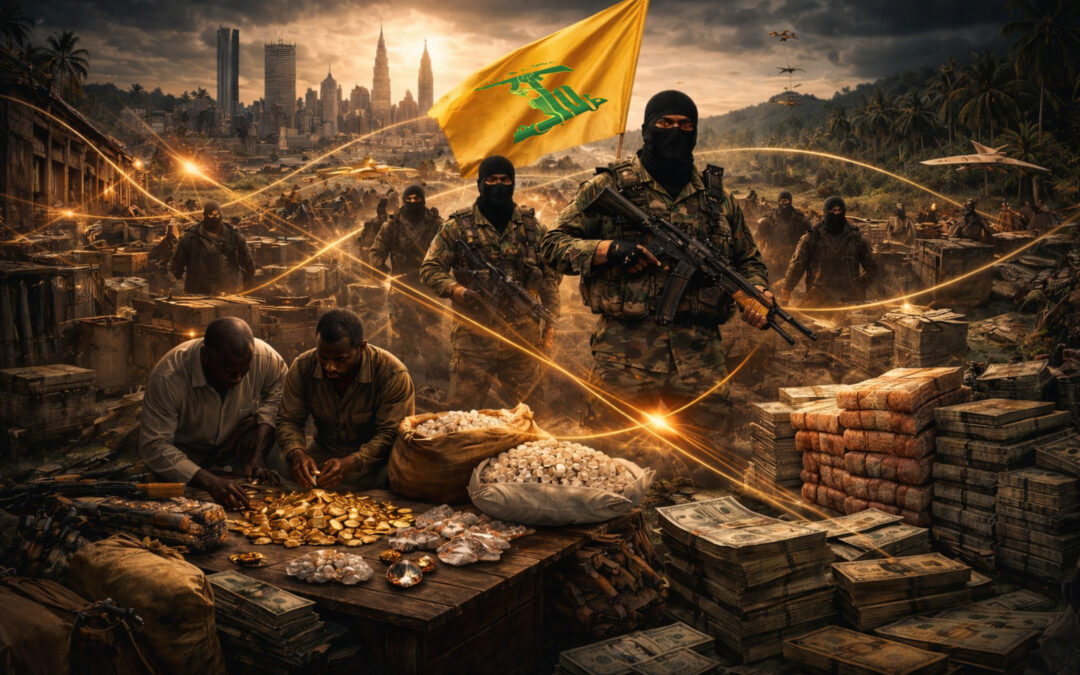
Hezbollah After the Fall of Assad: From a Military Arm to a Transcontinental Network of Terrorism, Financing, and Organized Crime
A Legal–Journalistic Analysis of the Group’s Activities in Lebanon, Syria, Yemen, Iraq, and Latin America (2025–2026)
.
By Dr. Abdelaziz Tarekji
Investigative Journalist and Researcher in International Human Rights Violations
.
On December 8, 2024, the dictatorial regime of Bashar al-Assad collapsed in Syria, bringing to an end an entire phase during which the country had functioned as an open arena of influence for Iran and its armed proxies. A transitional phase followed, marked by the expulsion of Iranian militia presence and the opening of a highly sensitive file concerning the fate of the criminal and terrorist networks that had expanded under the cover of war, chaos, and state collapse.
Yet the strategic shock suffered by Hezbollah following the loss of its Assad-era depth did not translate into withdrawal or retrenchment. Instead, it exposed a far more dangerous reality: an organization whose power does not rest on geography alone, but on a transnational logic forged over years of conflict—one that combines a parallel economy, shadow financing, networks of smuggling and money laundering, commercial and security front entities, as well as military and intelligence roles that relocate wherever institutional vacuum, disorder, and weak oversight prevail.
This is not an article engaging in a political dispute with a Lebanese party. It is a documented legal–journalistic characterization of the conduct of an organization designated on international and Arab terrorism lists, and pursued globally as part of systems of illicit financing, armed violence, and transcontinental terrorism. This characterization is grounded in published facts, sanction regimes, United Nations resolutions, and binding international conventions—not in slogans or ideological positions.
.
I. Syria After Assad: From an “Open Arena” to “Post-Exposure Cells”
For many years, Syria constituted for Hezbollah a logistical corridor and operational depth in direct contact with Lebanese geography. It also represented a central link in the transborder supply chain that—according to recurring descriptions in security reports and specialized media—connected Tehran, Baghdad, Damascus, and Beirut, encompassing the transfer of expertise, weaponry, recruitment, and the entrenchment of influence under the cover of war and institutional collapse.
With the end of the Assad family’s rule and Syria’s entry into a transitional phase, indicators multiplied showing that networks expanded during wartime do not disappear overnight. Rather, they reposition themselves through clandestine operational patterns: small cells, hidden depots, launch platforms, smuggling routes, and recycled front structures, typically followed by denial, disinformation, and attempts to exploit social divisions and sectarian incitement to reduce the cost of exposure.
In this context, local Syrian reports in September 2025 spoke of the arrest of a cell near Damascus and the seizure of missiles and military equipment, while Hezbollah denied any connection.
A more recent and sensitive episode followed in late January and early February 2026, when the Syrian Ministry of Interior announced the dismantling of a “cell” and the arrest of its members after missile attacks targeted the Mezzeh area and the Mezzeh military airport in Damascus. Authorities stated that the seized weapons and drones were linked to a Lebanese source and attributed the operation to Hezbollah, which responded with a formal denial.
Regardless of the final judicial outcomes of these cases, the pattern of “post-exposure cells” carries a clear legal significance: the use of missiles, explosives, or drones against populated neighborhoods or military facilities within an urban setting falls, under internationally recognized counterterrorism standards, within organized violence aimed at spreading terror and undermining public security. When such acts are linked to financing and smuggling networks, they acquire the defining features of transnational organized crime.
Conclusion of this axis: the collapse of political cover in Syria does not signify the end of the networks, but their transition into smaller, more secretive structures, while preserving the same underlying logic: violence + financing + smuggling + denial. These elements justify classifying the phenomenon as an organized threat that transcends borders, rather than a mere extension of a domestic conflict.
.
II. Lebanon: A “Parallel Economy” That Precedes the Gun and Grants It State-Level Immunity
The most dangerous transformation in Hezbollah’s structure inside Lebanon does not lie solely in its retention of weapons outside the framework of the state, but rather in the construction of a parallel system that exerts control through finance, economics, administration, and security influence. This system enables the organization to operate beneath the umbrella of the state and through its structural gaps, rather than through direct confrontation with it.
On the financial level, Hezbollah has over recent years entrenched a fully integrated shadow economy—comprising unregulated financial institutions, associations, currency exchange networks, commercial front companies, and cross-border activities—that ensures sustained financing and organizational continuity, while softening the impact of sanctions, isolation, and shifting regional dynamics. This economy does not function in a vacuum; it feeds on weak official oversight and institutional overlap, thereby transforming financial power into political and security leverage.
Within this framework, the U.S. Department of the Treasury (OFAC) announced on July 3, 2025, sanctions against seven senior officials and an entity linked to “Al-Qard al-Hassan”, an institution controlled by Hezbollah, designating it as part of an organized financial evasion apparatus.
Likewise, Reuters reported on March 28, 2025, new U.S. sanctions targeting Hezbollah’s “finance team” and networks connected to commercial ventures and oil smuggling operations used to fund the organization’s activities. These measures were subsequently expanded on November 6, 2025, to include additional individuals and entities described as exploiting economic and financial channels tied to Hezbollah.
Yet the financial dimension cannot be separated from institutional cover. Accumulated evidence indicates that Hezbollah has, over many years, deliberately cultivated networks of influence and alliances within state institutions—civilian, military, and security alike—designed to ensure:
- Protection of the movement and mobility of its members and logistical routes,
- Reduction, delay, or neutralization of legal and security pursuit,
- Sustained informal coordination channels allowing operations to continue even under heightened secrecy.
This control is not necessarily exercised through direct orders, but through the gradual accumulation of influence, reciprocal interests, and the imposition of faits accomplis, resulting in a form of functional immunity that is generated within the state and through segments of its apparatus, rather than outside it. Here lies the core legal dilemma: a state sovereign in form, yet penetrated in practice by an informal structure capable of obstruction, protection, and circumvention of the law.
From the perspective of international law, this reality places Lebanon in material breach of its international obligations, particularly those arising under UN Security Council Resolution 1373 (2001), which obliges states to prevent any form of safe haven, material support, or institutional facilitation of terrorism, and to ensure that state institutions do not become channels of cover or assistance.
This situation also intersects with the provisions of the UN Convention against Transnational Organized Crime (Palermo Convention, 2000) when armed violence is combined with money laundering and smuggling within an organized structure that benefits from weak regulatory oversight.
.
State Responsibility in Cases of Penetration: International Standards and Breach of Duty
Under general international law, state responsibility is not measured solely by official declarations or legal texts, but by the effective exercise of authority and control over territory and institutions. When a state—through incapacity, collusion, or submission to a de facto reality—allows an organized armed group to operate within its borders outside the bounds of legality, while providing direct or indirect protection to its movement and financing, it enters the realm of international wrongful conduct.
UN Security Council Resolution 1373 (2001) establishes an unequivocal obligation on states to prevent all forms of support, facilitation, or protection of terrorist acts, including the denial of safe haven and the assurance that official institutions—military, security, or financial—are not exploited as transit routes or protective shields. Accordingly, systematic inaction, tolerance of a parallel economy, or tacit permission for a group to operate clandestinely under state cover constitutes a positive breach of international duty, not a mere administrative shortcoming.
The International Convention for the Suppression of the Financing of Terrorism (1999) reinforces this framework by obligating states to criminalize and prevent any financial activity that directly or indirectly contributes to armed violence against civilians or public order. Responsibility is not confined to the direct perpetrator, but extends to entire facilitation structures that enable the collection, transfer, concealment, or recycling of funds—including the use of ostensibly “social” or financial institutions as fronts.
The Palermo Convention (2000) further broadens the scope of responsibility when armed violence intersects with money laundering, smuggling, and abuse of influence within state institutions. Participation, contribution, or facilitation—even absent direct involvement in violent acts—falls within the definition of organized crime where a structured group, continuity, and benefit-oriented purpose are established.
Applied to the Lebanese case, a central legal paradox emerges: a state that formally asserts the monopoly on weapons, yet practically lacks the capacity or will to enforce it; that commits internationally to combating terrorist financing, while tolerating a shadow economy operating openly; and that maintains official security institutions functioning within an environment of political and security penetration that grants an armed organization de facto immunity.
This reality does not confine responsibility to the state as an abstract entity alone. It opens the door—under international law—to individual accountability of officials, entities, and persons whose involvement in facilitation, protection, or deliberate non-enforcement of the law can be established.
Legal conclusion: when a state ceases to function as a barrier against terrorism and becomes—through silence or incapacity—a permissive environment, it does not remain outside the scope of accountability. International law does not recognize fictitious neutrality in the face of organized terrorism, nor does it accept claims of “internal specificity” where transnational threats to international peace and security are concerned.
.
III. Yemen and Iraq: Combat Partnerships under Iranian Direction and the Circulation of Military Expertise
In Yemen, references to “advisers” or “technical expertise” are no longer merely descriptive media language; they have become a recurring operational pattern documented in United Nations reports and regional analyses. These sources link the transfer of combat know-how to the development of Houthi capabilities, including missile systems, unmanned aerial vehicles (UAVs), asymmetric warfare techniques, and battlefield management. This pattern does not reflect sporadic exchanges of experience, but rather a functional partnership operating within a single Iranian-backed support architecture, in which Hezbollah acts as a training, support, and execution node, drawing on its accumulated experience and its ability to operate beyond Lebanese territory.
Reports of the UN Panel of Experts on Yemen, operating under the authority of the Security Council, demonstrate the expansion of training and capacity-building among Houthi forces and the transformation of the Yemeni conflict into a closed market of military expertise, where tactics and technologies circulate rapidly from one theater to another. Parallel regional media reporting has attributed training and supervisory roles to figures linked to Hezbollah within this interconnected conflict, reflecting a division of labor: Iran provides strategic direction, financing, and weaponry, while Hezbollah delivers operational expertise and field-level knowledge transfer.
In Iraq, the same pattern of integration emerges within a more politically complex environment. The relationship between Hezbollah and Iranian-aligned armed factions is not confined to ideological alignment or symbolic support; it takes the form of operational coordination in training, logistical support, and expertise-sharing within a network operating under the direction of the Islamic Revolutionary Guard Corps (IRGC) and its Quds Force. This reality becomes particularly evident as Iraqi territory functions as a transit corridor for the movement of capabilities and experience between Iran, Syria, Lebanon, and Yemen, including the transfer of technologies and tactics through local intermediaries designed to reduce the costs of direct exposure.
The most revealing aspect of the Iraqi case is that political volatility within the state—where decisions on designation or asset freezes may be announced and later withdrawn under internal pressure—does not constitute a bureaucratic anomaly. Rather, it represents a structural condition that sustains transnational networks. Such networks do not thrive on state strength, but on state weakness and contradiction, exploiting the gray zones between formal sovereignty and operational reality.
.
Legal Characterization: From “Support for an Ally” to “Transnational Organized Terrorism”
From a legal standpoint, the transfer of military expertise, training, logistical assistance, and the provision of weapons or technical knowledge to armed groups operating outside the framework of the state constitutes material support for terrorism when linked to acts targeting civilians, public security, or the coercion of governments. This characterization is further reinforced when such support is embedded within a continuous organizational structure possessing leadership, resources, and financing, placing it squarely within the category of organized terrorism intersecting with transnational organized crime.
Conclusion of this axis: In Yemen and Iraq, Hezbollah does not operate as an independent actor, but as an integral component of a unified regional system directed by Iran, in which roles are distributed among planning, financing, training, and execution. These are combat partnerships that do not recognize borders, move wherever conflict exists, and draw strength from fragile states and political contradictions—making them, under international legal standards, an organized threat that transcends sovereignty and geography.
.
IV. Latin America: Where Money Is Easier Than Weapons, and Networks Become an “Operational Economy”
In Latin America, Hezbollah appears—according to academic studies and governmental reports—less as a conventional combat front and more as a system of financing, smuggling, and informal financial architecture. In this environment, military visibility is unnecessary; it is sufficient to construct financial and logistical arms within regions of porous borders and weak oversight, and to merge into the informal economy through front companies, currency exchange operations, goods smuggling, money laundering, and sanctions evasion.
A report by the RAND Corporation (March 2025) notes that the Tri-Border Area (Argentina–Paraguay–Brazil) has historically constituted a permissive environment for smuggling, money laundering, document forgery, and illicit trade, with persistent references to networks linked to Hezbollah operating within a broader organized crime ecosystem. The assessment underscores that the core threat in this theater is financial-operational rather than military.
The United States reinforced this assessment in practice through its “Rewards for Justice” program. On May 19, 2025, it announced a reward of up to USD 10 million for information leading to the disruption of Hezbollah’s financial networks in the Tri-Border Area—an implicit acknowledgment that the heart of the threat lies in money flows and logistics, not armed confrontation.
.
Venezuela and Colombia: “Illicit Gold + Cryptoassets + Front Structures”
In specialized literature, Venezuela is frequently described as a “permissive environment” for shadow economies, where informality intersects with illicit gold extraction and trade, contraband, and capital recycling, and where a weakened or politicized state acts as an enabler rather than a regulator.
In September 2023, the U.S. Department of the Treasury imposed sanctions on a network linking Lebanon to South America, noting that some channels operated through commercial activities in Colombia, transferring proceeds for the benefit of Hezbollah, with extensions into Venezuela and the use of cryptoasset-related services and advisory mechanisms as part of a financial laundering scheme. This configuration exemplifies a classic front-economy model functioning outside the traditional banking system.
.
Nicaragua and Central America: Favorable Environments Enabling “Soft Presence”
With respect to Nicaragua, various Western political and security assessments cite the country among those that exhibit Iranian or pro-Iranian activity or interest in the region. These assessments warn of the instrumentalization of diplomatic and economic relations to create conditions that facilitate network mobility and concealment, even where publicly available detailed evidence is less extensive than in cases such as the Tri-Border Area or Venezuela.
.
The Diaspora as Leverage: Exploiting Social Ties Without Collective Criminalization
The central risk here is not the existence of migrant communities per se—which would constitute neither accusation nor collective stigmatization—but rather the ability of certain networks to exploit social and familial ties in order to construct financial intermediaries, trade brokers, front companies, and informal remittance systems. These mechanisms allow for the recycling of funds and the provision of logistical services under an appearance of legitimacy.
Academic literature describes this dynamic as a “hybrid model”, combining political or ideological discourse with illicit financing operations, thereby complicating detection and increasing the cost of state intervention.
.
Convergence of Interests with Gangs and Cartels: “Mutual Utility,” Not Formal Alliance
From a strictly legal perspective, multiple studies analyze convergences of interest between financing networks linked to designated terrorist organizations and the drug trafficking and smuggling economy in Latin America. In such intersections, the need to launder money and move commodities—gold, cocaine, and high-value goods—meets the availability of routes, forged documentation, and local operators.
This convergence may take the form of fee-based services, transit “taxes,” protection arrangements, or mechanisms such as the “Black Market Peso Exchange,” without necessarily implying a formal or organic alliance. Rather, it reflects functional cooperation grounded in mutual benefit.
.
Mexico: Regional Laundering Routes Do Not End at National Borders
The reference to Mexico must be understood within a regional framework. The country constitutes a central node in cartel-driven economies and money laundering routes, where the use of cryptoassets and alternative financial tools continues to expand. This reality situates Mexico within a regional financial ecosystem that transnational laundering networks may intersect with, even when their core cells are located elsewhere, such as the Tri-Border Area or Venezuela.
Conclusion: In Latin America, Hezbollah does not operate as a visible military force, but rather as a networked system of money flows, smuggling, and front structures, benefiting from porous borders and the organized crime economy. The threat here is therefore reticular—difficult to neutralize through a single security operation, but more susceptible to dismantlement through financial tracing, exposure of front entities, disruption of supply chains, and prosecution of money laundering offenses.
.
V. Africa: Turning the Diaspora into a Channel of Financing
In West Africa and other parts of the continent, investigative journalism and specialized research address the use of commercial and diaspora networks in building a parallel economy intersecting with money laundering and smuggling—diamonds, gold, timber, and high-value commodities—with significant difficulty in estimating the true scale of activity due to its opaque nature and reliance on front companies and unregulated transfer mechanisms.
This pattern appears, to varying degrees, in countries such as Côte d’Ivoire, Guinea, Sierra Leone, Senegal, Gambia, Benin, as well as the Democratic Republic of the Congo, where natural-resource sectors and informal markets are exploited as potential channels for recycling illicit proceeds.
Research centers and international reports indicate that the fragility of anti-money-laundering and counter-terrorist-financing frameworks in parts of Africa—whether due to legislative gaps, weak enforcement, or the scale of the informal economy—facilitates the transformation of certain markets into financial support nodes for transnational networks. This model relies on front companies, local intermediaries, over- and under-invoicing, convoluted supply chains, and heavy cash usage, complicating traceability and allowing networks to blend into the market rather than operate as visibly separate entities.
Conclusion of this axis: In Africa, activity associated with Hezbollah—according to these analyses—emerges primarily as a financing and economic support structure, anchored in shadow economies and diaspora-linked trade networks. Effective countermeasures therefore hinge on drying up financial flows and strengthening AML/CFT enforcement, rather than pursuing limited or largely invisible military manifestations.
.
International Legal Framework: Why This Does Not Constitute “Resistance” Under Law
International law does not recognize labels or slogans; it judges conduct and consequences. Any violence targeting civilians, or financed through smuggling, money laundering, or criminal economies, falls immediately outside any legitimate legal characterization, granting neither “resistance” status nor immunity.
Over recent decades, the international community has constructed a strict and unambiguous legal framework leaving no room for circumvention: the financing of terrorism, its facilitation, and its concealment are autonomous crimes, even prior to the commission of a violent act.
1) UN Security Council Resolution 1373 (2001)
This resolution goes beyond condemnation, imposing binding obligations on all states: criminalizing financing, denying safe haven, prohibiting logistical support, blocking training, armament, and mobility, and ensuring that state territory and institutions are not transformed into corridors or shields for armed groups. Under this framework, liability is not limited to the direct perpetrator, but extends to any actor who facilitates, tolerates, or provides effective protection.
2) International Convention for the Suppression of the Financing of Terrorism (1999)
This convention draws a categorical line: financing is an independent offense, whether or not funds are ultimately used, and whether directed toward weapons, training, propaganda, or front entities. Crucially, no political, ideological, or religious justification is admissible—the end neither legitimizes the means nor cleanses money or bloodshed.
3) UN Convention against Transnational Organized Crime (Palermo Convention, 2000)
When weapons intersect with money laundering, smuggling, and commercial fronts, the narrative of “resistance” collapses, giving way to a structured criminal organization defined by continuity and resources. The convention criminalizes not only execution, but also participation, facilitation, and concealment, mandating judicial cooperation and cross-border prosecution.
4) 1988 Vienna Convention against Illicit Traffic in Narcotic Drugs
This instrument completes the chain: when narcotics and their proceeds are used to finance weapons and violence, drugs, money laundering, and terrorism become a single criminal continuum. Tracing proceeds and drying up sources becomes an international obligation, not a political option.
Accordingly, when an armed group intersects with illicit financing systems—smuggling, laundering, sanctions evasion, and parallel economies—it enters legally and objectively the realm of transnational organized crime, prior to any debate over identity, slogans, or narrative.
Legal conclusion: In international law, there is no “in-between” armed actor:
either conduct is lawful and subject to state authority and the rule of law,
or it constitutes a terrorist-criminal organization operating as a parallel power—a state within the state and a network within networks—pursued not for rhetoric, but for its actions, structure, and financing.
.
Final Conclusion
After the fall of the Assad regime, the central question is no longer whether Hezbollah lost Syria, but whether Lebanon, the region, and the international community possess the will and capacity to dismantle Iran-backed armed structures and Hezbollah’s parallel economy, which keeps the organization operational and enables it to offset losses on one front with gains on another continent.
What the years 2025 and 2026 reveal—through official documents, international sanctions, and security analyses—is not a collection of isolated measures, but a structural indictment: Hezbollah no longer relies on weapons alone, but on an integrated system of money flows, smuggling, money laundering, and front entities stretching from the Middle East to Africa and Latin America, operating through network logic rather than battlefield fronts.
Reducing confrontation to Lebanon’s internal arena is not merely a strategic error, but a form of political blindness. An actor functioning today as a transnational financial-logistical entity cannot be countered with sovereignty rhetoric or domestic balancing acts, but through resource strangulation, network disruption, and accountability for those who provide cover, facilitation, or silence.
The fall of Assad dismantled the illusion of a “unity of fronts,” but exposed a broader truth: Hezbollah is no longer the problem of a single state, but a transcontinental threat—and terrorist networks are defeated only when their money is broken before their weapons, and their structures are exposed before their slogans.