By Dr. Abdel Aziz Tarekji
Investigative Journalist and Researcher on International Human Rights Violations
.
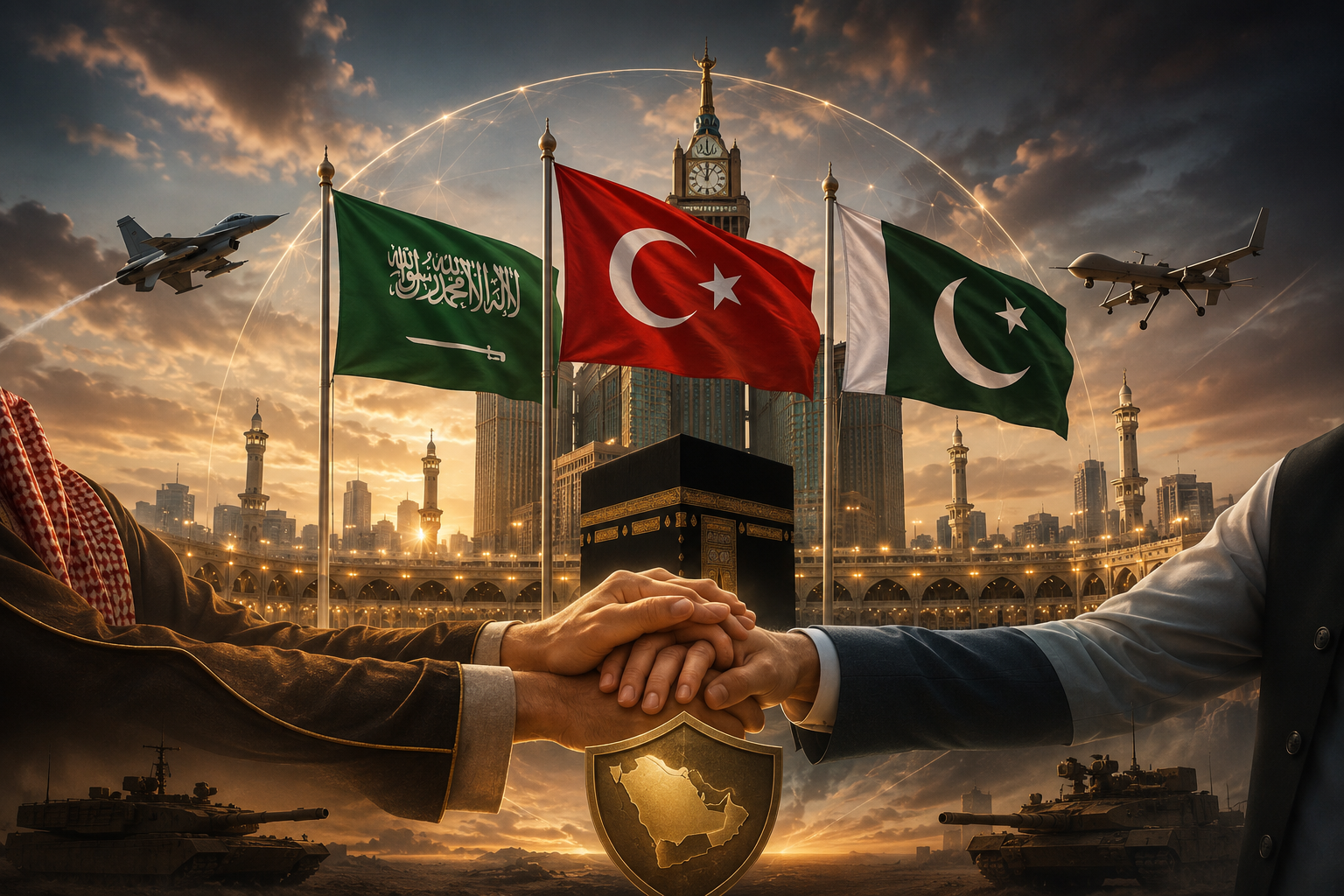
The Mecca Joint Defence Agreement, bringing together the Kingdom of Saudi Arabia, Türkiye and Pakistan on 7 August 2026, should not be viewed merely as another military accord added to an already dense network of defence arrangements in a region burdened by weapons, rivalries and competing alliances. A careful political and legal reading places the agreement within a far broader context: an attempt to establish a regional deterrence architecture led by three major Muslim states with considerable political, military and strategic weight, at a time when threats to Middle Eastern security increasingly exceed the capacity of any single state to confront them alone.
The agreement rests on a principle of profound significance: an attack against any one of the three states is to be regarded as an attack against them all. In defensive terms, this approaches the philosophy of collective defence underpinning established international military alliances. Turkish Foreign Minister Hakan Fidan described the principle, from a technical standpoint, as comparable to that embodied in Article 5 of the North Atlantic Treaty. Yet the publicly available details do not, at this stage, establish the kind of detailed operational commitments that would justify portraying the agreement as an Islamic version of NATO. Legal and political precision therefore requires avoiding such exaggeration.
The outlines of an implementation structure have also begun to emerge. Türkiye announced that the three countries would establish mechanisms bringing together senior ministers and officials, alongside joint military exercises and deeper cooperation in defence industries. This suggests that the agreement extends beyond a declaration of political solidarity and seeks to develop institutional capabilities capable of evolving over time.
.
From the Perspective of International Law: Deterrence Is Not a Declaration of War
The legal significance of the agreement begins with a fundamental distinction: collective defence is not the same as the creation of an offensive alliance.
Article 2(4) of the United Nations Charter prohibits the threat or use of force against the territorial integrity or political independence of states. At the same time, Article 51 recognises the inherent right of individual or collective self-defence in the event of an armed attack.
Accordingly, the establishment of a mutual defence framework between Saudi Arabia, Türkiye and Pakistan does not in itself depart from the rules of the international legal order, provided that its mechanisms remain within the boundaries of defence and deterrence and comply with the obligations established under the United Nations Charter.
Indeed, according to the declarations of the signatory states, the essence of the agreement is defensive and is not directed against any particular country. That distinction must be preserved because it marks the legal and political boundary between building strength to prevent war and employing force to initiate one.
This is precisely where one of Mecca’s most important messages lies: in an unstable regional environment, peace that is not protected by credible deterrent capacity risks becoming little more than a political aspiration.
.
Saudi Arabia: From De-escalation to Building Deterrence
It would be a mistake to interpret the agreement separately from the policies pursued by the Kingdom of Saudi Arabia in recent years, particularly under Crown Prince Mohammed bin Salman.
The Saudi project did not begin with a search for war. It began with an effort to extinguish wars, contain conflicts and reorganise the region around development and stability.
Riyadh pursued reconciliation with Iran, sought to prevent the region from sliding into a comprehensive confrontation, rejected the use of Saudi territory and airspace for military operations against Iran, and repeatedly expressed its readiness to mediate, de-escalate tensions and pursue negotiated settlements. In January 2026, the Saudi Crown Prince assured Iranian President Masoud Pezeshkian that the Kingdom would not permit its territory or airspace to be used for military action against Iran.
Even at the height of the latest escalation, the Crown Prince continued to advocate dialogue. In August, Reuters reported that Prince Mohammed bin Salman stressed, in a conversation with US President Donald Trump, the need to prioritise dialogue and reduce tensions, as part of efforts to prevent another round of confrontation.
These facts matter because they prevent the narrative from being turned on its head.
Saudi Arabia did not move towards deterrence because it abandoned peace. It did so because peace itself increasingly required the strength necessary to protect it.
.
When Moderation Fails to Persuade the Hardliners
Riyadh has sought to offer the region a different model: an economy instead of militias, development instead of proxy wars, investment instead of battlefields, and strong national states instead of countries fragmented into competing spheres of influence.
The problem is that Saudi political will alone cannot create regional stability.
Iranian intransigence on the one hand, and Israeli military policies that have repeatedly pushed the region towards the brink of wider conflict on the other, have contributed to an increasingly dangerous security environment—one that can no longer be managed through diplomacy alone.
It is important not to manufacture a false political equivalence between all parties, nor to assign responsibility for every Middle Eastern crisis to a single actor. But it is equally legitimate to state clearly that the region has paid an enormous price for an unchecked logic of force, whether exercised by a state exceeding the limits of legitimate defence or by a state employing transnational armed networks to advance its political and strategic objectives.
The danger ultimately reached the Kingdom itself. In March 2026, after Saudi Arabia was struck by Iranian ballistic missiles, Riyadh declared that it reserved the right to take military measures in defence of itself.
By August, Iranian threats had extended to warnings that oil facilities, electricity networks, water infrastructure and other critical assets across Gulf states could be targeted if US military operations against Iran continued—even as Saudi Arabia itself was urging Washington to pursue negotiations rather than expand the war.
This raises a legitimate question:
How many times must a state knock on diplomacy’s door before building deterrence becomes a duty owed to its people and its sovereignty?
The Message That Must Reach Tehran
The Mecca Agreement must not become a platform for hostility towards Iran. Nor does the Muslim world have any interest in a Sunni-Shia war or in dividing the region along sectarian lines.
But Tehran must nevertheless receive an unequivocal message:
Normal relations are built between states—not between a state and militias operating inside other states.
.
If Iran seeks stable relations with Saudi Arabia, Türkiye, Pakistan and the wider Arab and Muslim worlds, it must recognise that the era of using armed groups as proxies for regional influence must come to an end.
Respecting the sovereignty of Iraq, Yemen, Lebanon, Syria and other states is not a concession Tehran grants to anyone. It is a fundamental principle of international law, rooted in state sovereignty, independence and non-intervention in the internal affairs of other countries.
Iran cannot legitimately demand respect for its own sovereignty—a right that is beyond dispute—while simultaneously treating the sovereignty of other states as territory open to penetration through financing, weapons and armed organisations.
The trilateral agreement should therefore not tell Iran:
We want war with you.
.
It should tell Iran:
We want peace with you, but the era in which militias are made secure at the expense of states must end.
.
The Message Must Reach Israel as Well
At the same time, it would be both politically and morally mistaken to interpret the Mecca Agreement as pointing in only one direction.
Balanced regional deterrence also requires Israel to understand that military superiority does not constitute an unlimited licence to use force wherever it chooses, and that Israeli security—like the security of Iran, Saudi Arabia, Türkiye or Pakistan—cannot be built upon violations of other states’ sovereignty or by keeping the region in a permanent state of war.
A state that demands security for itself must recognise the right of others to security.
That principle cannot be applied selectively.
.
Why Saudi Arabia Can Lead This Course
This is where the deeper political significance of the agreement emerges.
Saudi Arabia is not simply a state endowed with wealth or strategic geography. It is the custodian of Islam’s two holiest mosques, a member of the G20, and a country whose Arab, Islamic, economic and political weight cannot be ignored.
Leadership in the twenty-first century, however, is not measured by slogans.
It is measured by the ability to combine political legitimacy, economic strength, defensive capability, diplomacy, development and moderation.
From this perspective, the Kingdom has demonstrated—and continues to demonstrate—that it is worthy of standing at the forefront of those capable of leading the moderate Muslim world. Not through domination over other Muslim states, but through the construction of a centre of gravity capable of bringing them together around shared interests.
The presence of Türkiye and Pakistan alongside Saudi Arabia gives this structure exceptional strategic depth.
Türkiye is a major military and industrial power and a member of NATO. Pakistan is a nuclear-armed state with a large military and extensive defence experience. Saudi Arabia, meanwhile, represents the Arab, Islamic, economic and political centre of gravity within this emerging equation.
If managed wisely, this is not an equation for war.
It is an equation for preventing war.
.
Mecca Is Not an Incidental Detail in the Agreement’s Name
Even the place carries a message.
The agreement was not named after a military base. It bears the name of Mecca.
For Muslims, Mecca is not merely a city within the borders of a state. In its spiritual meaning, it is the direction towards which more than a billion Muslims turn in prayer. Its name therefore gives the agreement a symbolism that transcends the political borders of the three signatory countries.
That symbolism places an even greater responsibility on Riyadh, Ankara and Islamabad: this agreement must not become a sectarian axis or an instrument for polarising the Muslim world. Instead, it should become the nucleus of a moderate security framework that respects state sovereignty and international law while rejecting terrorism, militias, expansionism and proxy warfare.
The Muslim world does not need a “sectarian NATO”.
It needs a system capable of saying to ally and adversary alike:
These are the borders of the state. This is its sovereignty. These are its people. No one has the right to tamper with them.
.
Mohammed bin Salman: Peace Needs the Strength to Protect It
The Mecca Agreement may reveal something deeper about Saudi Arabia’s strategic transformation.
Crown Prince Mohammed bin Salman has built a substantial part of his vision around the conviction that the Middle East cannot continue consuming its future in endless wars while other regions advance in economics, technology and investment.
De-escalation was therefore not peripheral to the Saudi project; it was a strategic necessity.
Yet recent years have also reaffirmed an old truth of international relations:
The desire for peace is not enough when others do not share that desire.
Building collective defensive capacity therefore does not contradict Saudi Arabia’s peace project. It may instead be the guarantee that allows that project to survive.
Diplomacy without strength can be tested indefinitely.
Strength without diplomacy becomes adventurism.
Bringing the two together is what creates deterrence.
.
From Mecca: Peace First—But Not Weakness
The purpose of the Mecca Agreement should not be to search for an enemy.
Its purpose should be to make aggression so costly that it never occurs.
That, in its simplest form, is the philosophy of deterrence.
Iran should regard this agreement as an opportunity to reconsider its policy of proxies and armed groups and to build state-to-state relations with its neighbours.
Israel should understand that the security architecture of the region cannot be dictated by the will of a single power.
And the major international powers should recognise that the leading states of the Muslim world no longer need to wait for others to design their security architecture for them.
Saudi Arabia, meanwhile, has placed itself through this agreement before a historic responsibility greater than the signing of any defence document: to lead a moderate Islamic project that does not seek war, but does not fear it when sovereignty and national security come under threat.
.
Riyadh tried to extinguish the fires.
It opened the doors of dialogue.
It extended its hand to its adversaries.
And it pursued de-escalation when the sound of weapons was louder than the voice of politics.
But moderation does not mean surrender, and peace does not mean leaving borders, infrastructure and populations at the mercy of missiles and militias.
Perhaps, then, the most important message to emerge from Mecca is simple in its wording, yet profound in its implications:
We want a region without wars. But whoever seeks peace with us must first respect our states, their sovereignty and the security of their peoples.
.
In a region exhausted by war, this may be precisely the kind of leadership the Muslim world needs today:
A leadership that extends one hand in peace, while keeping in the other enough strength to protect that peace.